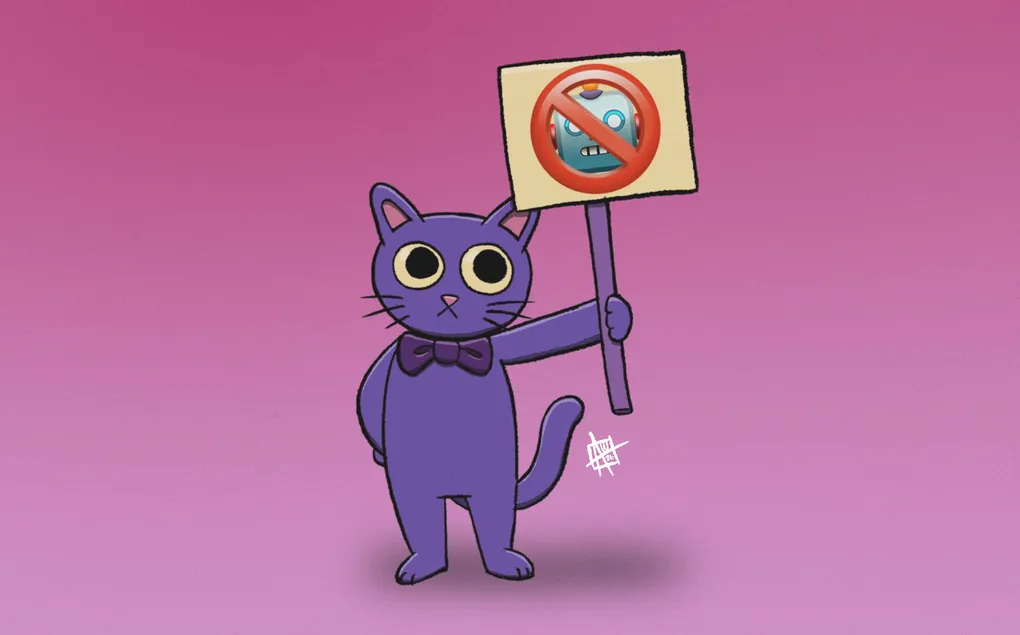
Where We Draw the Line on AI
(I decided to move this up to be the second blog post on the game because I feel it’s an important thing to address this early in development. The next blog post after this will be more development focused.)
I’m making a game that satirizes AI culture, and I’ve recently been asked a few times if AI is used for development of the game. The short answer is NO when it involves anything that showcases human creativity. My longer answer is this:
EIDOLWARE is, at its core, a story about what happens when people put too much faith in technology without thinking through the consequences. So believe me when I say I’m not approaching this as an evangelist.
The gaming community, indie developers, artists, voice actors, and plenty of people across social media have strong feelings about AI. A lot of those feelings are justified. Artists have watched their work get scraped into training datasets without consent. Voice actors have seen companies try to replace them with synthetic voices. Indie developers have watched a flood of AI-generated asset flips hit storefronts, diluting the market with products that nobody actually crafted. The environmental cost of training and running these models, the energy and water consumed by massive data centers, is something the industry has barely begun to reckon with. When people hear someone say “I used AI,” they’re right to ask what that means, because the answer matters.
So here’s what it means for me, and here’s what it doesn’t.
My day job is in software engineering, where AI tools have become part of the workflow to varying degrees. I’ve seen firsthand both the promises and the dangers of it. I’ve seen it save hours on tedious work, and I’ve seen it confidently produce garbage that would have taken longer to fix than to write from scratch, but with every new model that part becomes eerily less common. That professional experience shaped how I think about the technology. I won’t pretend I have all the answers, but through that experience I can see slivers of where it could be used ethically, where it can genuinely assist people without replacing them or undermining their work.
Steve Jobs, for all his faults, popularized a phrase that stuck with me: the computer as “a bicycle for the mind.” A tool that amplifies human capability without replacing human effort. That’s how I like to think an ethical version of AI can become. But getting there means it has to be shaped by people with good intentions, not governments and corporations driven by uncompromising greed. And like any tool, the question isn’t whether you use it. It’s how you use it, and where you draw the line between the tool doing its job and the tool doing your job.
I don’t use AI to generate art or assets for EIDOLWARE. Every sprite, every background, every character design is drawn by hand. I’m an illustrator. That’s my craft, and I’m not outsourcing it to a model trained on other people’s work. I don’t use AI to generate music. I have a composer who writes original tracks for the game. I don’t vibe code. I’m not prompting a model to design mechanics or generate ideas for me. The closest I may get is using it as a debugging partner, a second set of eyes when I’m tracking down a race condition or trying to decipher why a specific edge case is breaking my event system. In that case it is merely giving me hints and that’s not the AI building my game. That’s me using a tool to solve a specific technical problem faster, the same way I’d use a profiler or a debugger. And when it comes time to cast voice actors, I will sign a NAVA AI rider committing to protections for every performer’s voice and likeness.
These aren’t marketing gestures. They’re boundaries I set because I want to do my best to avoid generative use where it can corrupt the craft and artistry of the game. The people doing the creative work on this project deserve to know their contributions won’t be fed into a system that replaces them.
I’m not going to pretend I’m fully at peace with how these models were built. In rare cases, I will utilize the technology in transparent and narrow ways away from the core human craft while feeling conflicted about the technology, and I think that’s a more honest position than pretending the conflict doesn’t exist. I feel that helps me be an honest storyteller and game developer with firsthand knowledge to be able to satirize the technology and other subjects surrounding it.
I drew hard lines around where AI touches the actual game, and I think those lines matter. When people eventually play EIDOLWARE, I want them to feel how genuine of a passion project it is.
- Ryv, FATBAT Studio